

Total Ankle Replacement in Newcastle, Maitland, Central Coast & the Hunter Region

Pain Relief, Function, Quality of Life & Long-Term Outcomes
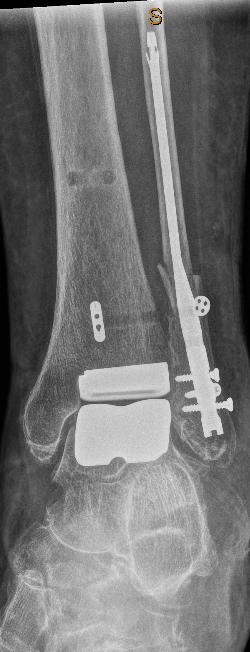
If you are living with ankle arthritis in Newcastle, Lake Macquarie, Maitland, the Hunter Valley or the Central Coast, you may have been told that ankle fusion is the only surgical option.
Modern Total Ankle Replacement (TAR) — also called total ankle arthroplasty — is now a well-established treatment for end-stage ankle arthritis. Contemporary research shows strong improvements in pain, walking ability and overall quality of life.
Below is what the scientific evidence tells us.
How Much Pain Relief Does Ankle Replacement Provide?
Modern studies of third-generation implants consistently show:
80–90% of patients experience significant pain relief¹
Most improve by 4–6 points on a 10-point pain scale
The majority report minimal or no pain at one year
Systematic reviews comparing ankle replacement with ankle fusion show similar pain relief between procedures.²
For patients across Newcastle and the Hunter region, this usually means walking without daily arthritic pain.
How Do We Measure “Function” After Ankle Replacement?
Researchers don’t rely on surgeon opinion — they use validated scoring systems.
AOFAS Score
The AOFAS score, developed by the American Orthopaedic Foot & Ankle Society, measures:
Pain
Walking ability
Range of motion
Stability
It is scored from 0 to 100 (higher is better).
After ankle replacement, studies typically show:
30–40 point improvements on average¹
That is considered a large and meaningful improvement in daily function.
Does Ankle Replacement Improve Quality of Life?
Yes — and this is measured using broader health questionnaires.
SF-36
The SF-36 (Short Form-36) measures overall health
including:

Physical function
Pain
Energy
Social participation
Scores are standardised to a population average of 50.
Studies show significant improvements in the physical health component after ankle replacement.³
PROMIS
The PROMIS system, developed by the National Institutes of Health, is a modern patient-reported outcome tool used widely in orthopaedics.
PROMIS Physical Function scores:
Are standardised to a population average of 50
Increase as physical ability improves
After ankle replacement, improvements of 10–20 points are commonly reported.⁴
For patients in Lake Macquarie, Maitland and the Central Coast, this often translates to:
Better sleep
Easier travel
More confidence walking outdoors
Improved independence
What Activities Can You Return To After Ankle Replacement?
Return-to-sport studies show:⁵ ⁶
Activity | Approximate Return Rate |
Recreational walking | 95%+ |
Cycling | 90–95% |
Swimming | 95% |
Golf | 85–95% |
Hiking (moderate terrain) | 70–85% |
Doubles tennis | 50–70% |
Light jogging | 10–30% |

High-impact pivoting sports such as soccer or basketball are generally discouraged to reduce implant
wear.
For most patients seeking ankle replacement in Newcastle or the Hunter Valley, the goal is comfortable walking, golf, cycling and travel — not elite sport.
How Long Does an Ankle Replacement Last?
Joint registries track revision surgery nationally.
Revision surgery means the ankle replacement needs to be re-done, a component needs to be exchanged or the ankle replacement needs to be converted to an ankle fusion.
The Australian Orthopaedic Association National Joint Replacement Registry (AOANJRR) collects ankle replacement data across Australia.
International registry analyses that include Australian data report:
Approximately 80–90% revision-free survival at 5 years⁷,8
Approximately 75–85% survival at 10 years⁷,8
Younger and highly active patients have higher revision risk.
Registry data is important because it reflects real-world outcomes across entire populations, not just single surgeons.
What Are the Risks or Downsides?
Like any surgery, total ankle replacement carries risks.
Early risks:
Wound complications: 5–15%
Infection: 1–4%
Nerve irritation: 5–10%
Blood clot: <2%
Long-term considerations:
Implant loosening or wear
Possible need for revision surgery
Persistent stiffness
Mild ongoing discomfort (10–20%)
Compared with ankle fusion:
✔ Preserves motion
✔ More natural walking mechanics
✖ Slightly higher reoperation rate in some studies²
Is Total Ankle Replacement Right for You in Newcastle or the Hunter Region?
You may be a candidate if you have:
End-stage ankle arthritis
Daily pain affecting walking
Failure of non-surgical treatment
Realistic expectations regarding high-impact sport
Modern ankle replacement offers many patients across Newcastle, Lake Macquarie, Maitland, the Hunter Valley and the Central Coast meaningful pain relief, improved mobility and better quality of life.
It is not a “normal ankle” — but for many patients, it is a far more comfortable and functional one.
References
Haddad SL et al. Intermediate and long-term outcomes of total ankle arthroplasty. J Bone Joint Surg Am. 2007.
Krause FG et al. Ankle arthrodesis versus total ankle arthroplasty: systematic review. Clin Orthop Relat Res. 2011.
Daniels TR et al. Prospective comparison of ankle arthroplasty and arthrodesis. J Bone Joint Surg Am. 2014.
PROMIS Physical Function outcomes in total ankle arthroplasty cohorts.
Valderrabano V et al. Sports activity after total ankle arthroplasty. Am J Sports Med. 2006.
Naal FD et al. Return to sports after total ankle arthroplasty. Foot Ankle Int. 2009.
Zhao H, et al. Survival analysis of total ankle arthroplasty based on registry data. J Orthop Surg Res. 2021;16:405.
Henricson A, Nilsson J-Å, Carlsson Å. 10-year survival of total ankle arthroplasties: a report on 780 cases from the Swedish Ankle Register. Acta Orthopaedica. 2011;82(6):655-659. doi:10.3109/17453674.2011.636678.
Comments